
There’s a moment every backend engineer knows. You write a migration, it runs clean on your laptop, it runs clean on staging, and then you push it to production at 11 p.m. because “it’s a small change.” Somewhere between that laptop and that production database, an ALTER TABLE that took 40 milliseconds locally decides to take a full-table lock on a live table, and suddenly guests can’t join a VoiceMeet Pro call because the connections table is stuck.
That happened to me. Not catastrophically — nobody lost data, nobody got paged at 3 a.m. because there’s no one else to page — but it was enough of a scare that I stopped treating migrations as a checkbox and started treating them as a discipline. This is the honest version of that story: what I was doing wrong, what the industry actually considers table stakes in 2026, and where VoiceMeet Pro’s migration pipeline stands today — gaps included.
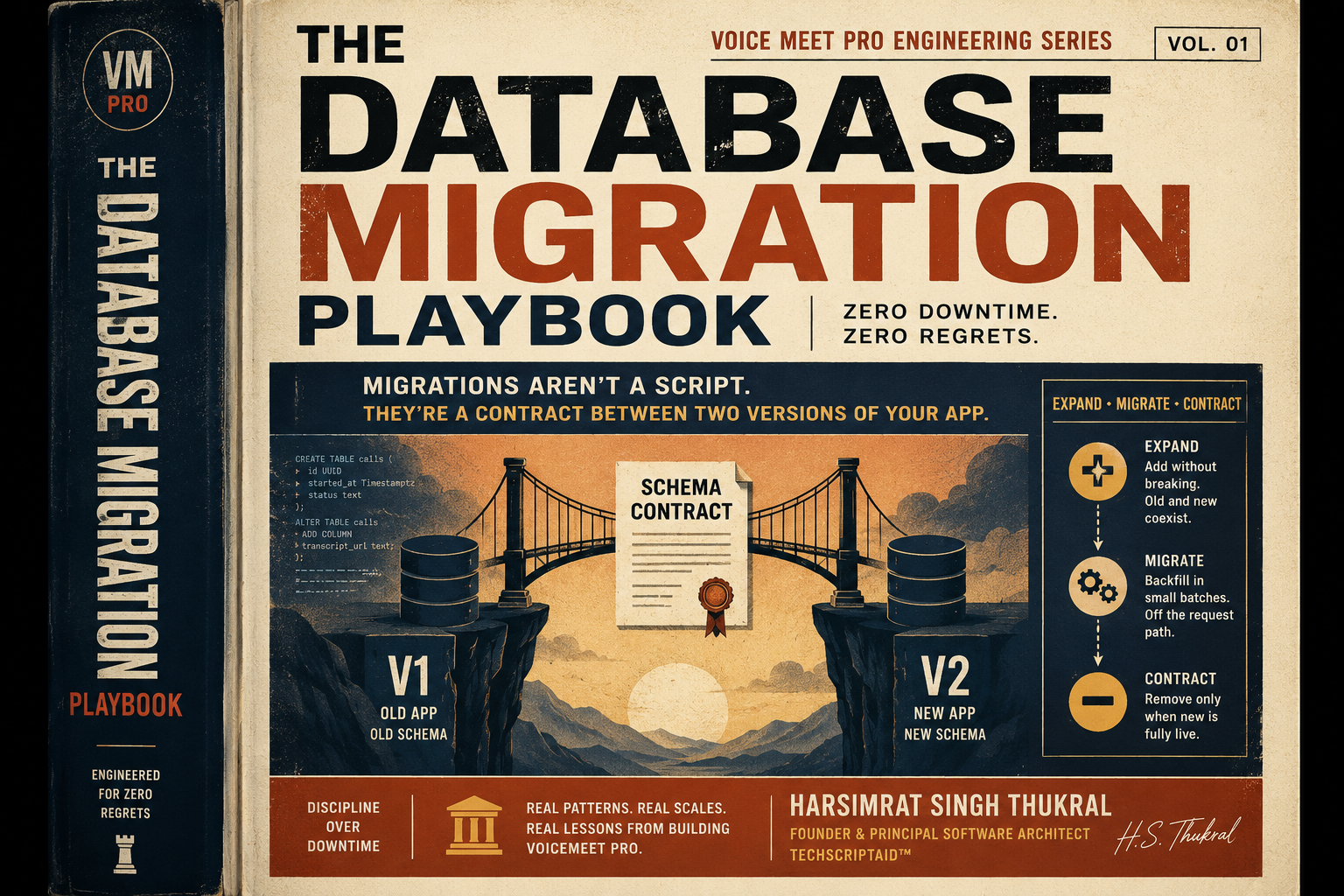
Migrations aren’t a script. They’re a contract between two versions of your app.
The single biggest shift in how enterprise teams think about migrations right now isn’t a tool — it’s a mental model called expand-contract (some call it parallel change). Instead of one migration that changes the schema and the application at the same time, you split it into three stages.
  EXPAND                    MIGRATE                     CONTRACT
  add new column/table  →   backfill in small batches →  drop the old shape
  old code: still works     app stays live the whole time   only after every
  new code: already works                                    instance reads new
It sounds obvious written down. It is not obvious at 11 p.m. when you’re tired and just want the ticket closed. What it buys you is real: your old app version and new app version can both be alive during a rolling deploy without either one crashing on a column that doesn’t exist yet — or one that got dropped too early.
For VoiceMeet Pro, I’ve applied this properly on the newer additive changes — adding transcription metadata columns, admin dashboard fields — but I’ll be honest, a couple of the earlier schema changes from the December–January build sprint were done the old “just alter it” way because I was racing toward Play Store approval. That’s the gap I’m closing now, not pretending it never existed.
Branch your database like you branch your code
Here’s where I have to be honest about a gap, because running on Neon and not using this feels almost wasteful in hindsight. Traditional Postgres migration testing means either a shared staging database that everyone steps on, or a full local copy that drifts from production the moment nobody’s looking. Copy-on-write branching solves this properly: fork the production database — full schema, full data, in seconds, not gigabytes copied — run the migration against the branch, run the integration suite against that branch, and only promote to production once the branch proves it’s clean. The branch costs almost nothing and gets thrown away after.
Right now, VoiceMeet Pro doesn’t do this. I test migrations against a local copy and staging, the way most solo-built products do, and it has worked so far mostly through caution rather than process. But “worked so far” isn’t a strategy, and branch-per-migration is exactly the kind of thing that turns “I think this is safe” into “I ran it against a real copy and it was safe” — which is why it’s next on the list, not a nice-to-have I’ll get to eventually.
A migration that “worked in staging” has told you nothing about production. A migration that ran clean against a real branch of production has told you something.
The CI gate that actually catches things
A migration file sitting in a pull request means nothing if a human is the one deciding whether it’s safe. The pattern serious teams run in 2026 is a migration linter in CI that fails the build automatically on the known dangerous patterns:
- Adding a
NOT NULLcolumn without a default (locks the table while it backfills) - Adding a foreign key without
NOT VALID+ a separateVALIDATE CONSTRAINT(same lock problem) - Renaming or dropping a column still referenced in application code
- Any migration missing a corresponding rollback script
Tools like Atlas and newer versions of Liquibase now do a lot of this analysis for you — treating schema as versioned, diffable code rather than a folder of hand-written SQL files hoping for the best. VoiceMeet Pro doesn’t have this wired in yet. Right now the safety net is me reading my own migration before I run it, which is exactly the single point of failure this whole article is arguing against. An Atlas-based lint step in the same GitHub Actions pipeline that already runs VoiceMeet Pro’s CI, alongside the AppError and structured-logging checks from the engineering playbook, is the next piece I’m building.
Where I’m not going to oversell this
I want to be straight with you rather than dress this up. VoiceMeet Pro does not yet run fully automated blue-green schema promotion, and I don’t have a shadow-traffic replay system checking migrations against real production query patterns before they ship — that’s genuinely enterprise-scale infrastructure, the kind of thing you see written about at companies running fleets of database clusters, not a solo-founder SaaS.
What I do have, today, is expand-contract as the default for every new schema change. What I don’t have yet — and what’s on the roadmap, not just an idea — is branch-based testing before a migration touches production, and an automated lint gate that refuses to let a locking migration merge silently. Naming that gap in public is the point of this article as much as anything else in it.
That’s not a secret formula nobody else knows. It’s the boring, disciplined version of what the best teams already do — the version that doesn’t make headlines but also doesn’t wake you up at night wondering if a call is going to drop mid-migration.
FAQ
What is the expand-contract pattern in database migrations?
A three-stage approach — expand, migrate, contract — that lets an old and a new version of an application run against the same database schema at the same time, which is what makes a rolling deployment safe.
Why use database branching for migration testing?
Copy-on-write branching lets you test a migration against a real, full copy of production data in seconds, without touching live traffic or paying for a permanent duplicate database.
What migration tools support automated schema linting?
Tools like Atlas and recent versions of Liquibase can catch dangerous migration patterns — such as a blocking NOT NULL addition or an unvalidated foreign key — automatically in CI, before they ever reach production.
Does VoiceMeet Pro use these practices today?
Partially. Expand-contract is the default for new schema changes. Branch-based testing and an automated CI lint gate are on the roadmap but not built yet — that gap is described openly here rather than glossed over.
Written by Harsimrat Singh, the solo builder behind VoiceMeet Pro, a voice-meeting app shipped and maintained with AI, live on the Play Store. Field notes on what building on serverless Postgres actually feels like in 2026.
Leave a Reply