
Been playing since 1996. Thirty years now. I’ve gone through more rubbers than I can count — Sriver, Mark V, Bryce, Tenergy 05, Tenergy 64, Hurricane 3, Hurricane 8, Goldarc 8, Goldarc 9, Bluefire M1, M2, M3, Rakza 7, Rakza X, Tibhar Evolution variants, the older Andro Rasanter range. Some were brilliant for what I was doing at the time. Some were wrong for me and I knew within a week. A few I held onto longer than I should have because I didn’t want to admit they weren’t working.
That’s the actual lesson from three decades. The rubber industry doesn’t release bad rubber. They release rubber that fits a certain kind of player, and your job is to know which kind you are this year. Not five years ago. This year.
I played my first vets category tournament last month. Lost 0-3 in every match. One game went 3-10, the rest were close. Losing didn’t bother me. I’ve lost plenty of matches in 30 years. What it did was give me a clean reason to sit down and look properly at what I’m holding on the table now, at this age, with this body, with the way I actually play in 2026.
Why I stopped trusting rubber reviews
Here’s what I keep telling the younger guys at the club who ask me for equipment advice. Forget reviews. Every reviewer has found the rubber. Every rubber is amazing. And every recommendation contradicts the next one. A review is one guy describing how his hands felt on his strokes against his opponents. None of that is you. The reviewers raving about Dignics 09C are mostly young, drilling three hours a day, hitting every loop at full commitment. I’m 40-plus, vets category, and about 60% of my backhand is touches and blocks, not power loops. 09C would feel dead in my hand because I don’t hit hard enough to wake the sponge up. Not the rubber’s fault. Just the wrong match.
What I check before changing anything
So what I do now is simple. Before I change anything, I watch myself. I film three sessions and watch them on mute. And I count honestly how often I actually commit to a full stroke versus how often I’m pushing, blocking, floating. The number’s always lower than I think. Younger guys buy rubber for the ten percent of shots they hit big and ignore the sixty percent they don’t. That’s backwards.
Then I find the one shot that keeps costing me points. Not “my backhand is inconsistent.” That tells you nothing. I mean specific. For me it was backhand flat-brush against a low ball with light topspin, into the net, every time, at low effort. If you can’t describe the problem that precisely, you haven’t looked at it yet. You’re just complaining.
I also check where I actually stand. Marked the floor once and watched the video back. 30 to 50 cm on backhand. Close. Most guys will tell you they play mid-distance. The video says otherwise.
And I ask people I’ve beaten what they hated about playing me. Don’t guess this one. Two guys told me the same thing — heavy ball, weird kick after the bounce. Nobody said I was fast. That’s been true my whole life. I’m a spin player. The rubbers I’ve stuck with longest have all been on the spinny side.
The physics most people get wrong
Quick physics, because this is where most guys go wrong. The hardness number on the box on its own is misleading. Two rubbers with the same 47.5° ESN sponge can play completely differently depending on the topsheet sitting on top. Tacky topsheet grabs the ball without you doing much. Non-tacky topsheet needs you to commit before it does anything. That’s literally why 09C reviews are what they are — written by guys who always commit. And the hardness scales don’t match across brands either. 47.5° ESN is roughly 38° JIS, 50° ESN is roughly 40° JIS. Anyone quoting one number without telling you which scale, walk away.
My current setup
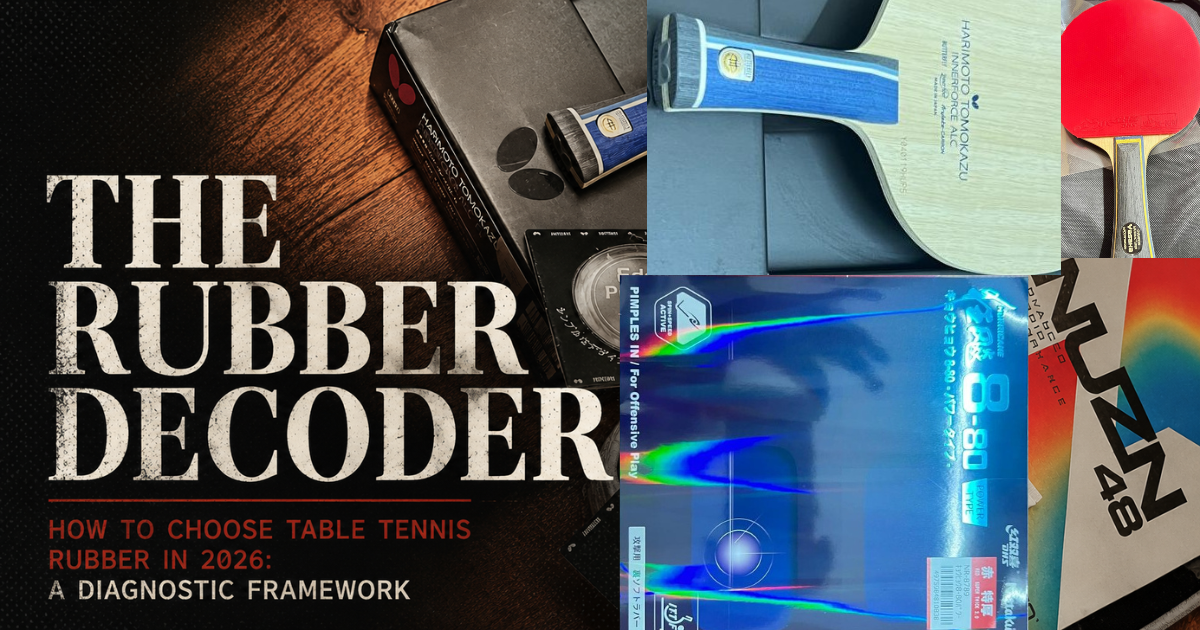
My current setup is Butterfly Harimoto Innerforce ALC blade, Nittaku Hurricane 8-80 Power on forehand at 2.0 mm, and Andro NUZN 48 on backhand at 2.0 mm. The blade is inner carbon, balanced, doesn’t force me into one style. The 8-80 Power is semi-tacky and comes pre-treated so I’m not boosting it by hand every few weeks like a regular Chinese rubber. The NUZN 48 is a slightly tacky hybrid that grips the ball on horizontal contact without needing full commitment. Both rubbers sit in the same tacky family, which means one stroke calibration across both wings. That last bit matters more than people realise. Run a tacky forehand with a non-tacky backhand and your cross-wing transitions never feel quite right.
How the candidates stacked up
Here’s how the candidates stacked up when I was deciding. I wrote this down at the time because I was tired of going round in circles in my own head.
| Rubber | Wing | Sponge | Topsheet | Why in or out for me |
|---|---|---|---|---|
| Hurricane 8-80 Power | Forehand | 47.5° ESN | Semi-tacky, pre-treated | Chose this. Tacky feel I wanted, sponge responds when I commit, no manual boosting. |
| Rakza Z | Forehand | 50° ESN | Tacky | Too heavy for the Harimoto. Would have killed the balance. |
| Jekyll & Hyde C52.5 | Forehand | 52.5° ESN | Tacky | Reviewed as slow for its hardness. I play mid-distance, the ball has to travel. |
| Glayzer 09C | Forehand | 42° JIS | Tacky | Lighter and forgiving but no headroom for me. Would feel capped within a month. |
| Dignics 09C | Forehand | 44° JIS | Tacky | Almost bought it. Honest answer was I’d fight it for three months and quietly downgrade. Not my level right now. |
| NUZN 48 | Backhand | 48° ESN | Slightly tacky hybrid | Chose this. Grips on horizontal contact at low effort, blocks clean, same family as the forehand. |
| Victas V>22 Double Extra | Backhand | 47.5° ESN | Soft grippy | Solid rubber but reviewed as sensitive on blocks. I block well. Wasn’t giving that up. |
| Tenergy 19 | Backhand | 36° JIS | Non-tacky grippy | Activates at low effort, would have solved the flat-brush problem. But non-tacky means a second calibration across wings. Too much to manage. |
The candidates I weighed, and why each one was in or out.
The table makes the logic look cleaner than it actually was. In real life I sat with this for two weeks, kept flipping between Jekyll & Hyde and the 8-80 Power for the forehand, and only settled when I admitted I wasn’t going to suddenly start playing closer to the table to suit a slower rubber. That’s the part that doesn’t fit in a table — the honest conversation you have to have with yourself about how you actually play, not how you’d like to.
I almost went with Dignics 09C on forehand. Every player I respect uses it. Sat with the idea for a few days. The honest answer was I’d spend three months fighting it and quietly go back to something softer, and pretend I’d planned it. So I didn’t. The rubber that makes a national player great makes a vets player worse half the time. Equipment doesn’t pull you up to a level. It either matches where you’re at or it doesn’t.
That’s where I am. Setup feels right. Tournament losses told me what I needed to know. Going into the next one with gear that fits how I actually play now, not how I played ten years ago.
If you’ve been at this for a while like I have, the equipment cycle gets quieter as you get older. You stop chasing what the pros use. You stop buying because someone on YouTube said so. You start picking rubber the way you’d pick shoes for a long walk — based on the walk you’re actually going on, not the one you wish you were going on.
That’s all there is to it.
Common questions
Is Dignics 09C a good rubber for club and veteran players?
It’s engineered for players who hit every loop at full commitment. Veteran and club players whose strokes spend most of the match at 60-70% effort often find it feels dead because the sponge does not activate. The rubber is excellent — it’s the match between rubber and player that fails.
How do I convert ESN hardness to JIS hardness?
It’s approximate, not exact. 47.5° ESN is roughly 38° JIS. 50° ESN is roughly 40° JIS. 52.5° ESN is roughly 42-43° JIS. Always check which scale a brand is using before comparing rubbers across brands.
Should the forehand and backhand rubber be from the same family?
If you can manage it, yes. Matching the topsheet family across both wings means one stroke calibration to learn instead of two. Mixed setups are workable but cross-wing transitions never feel as smooth as a unified family.
Why did I choose Hurricane 8-80 Power over Dignics 09C for the forehand?
The 8-80 Power activates at lower effort levels, which matches how I actually play in a vets match. 09C demands consistent high-commitment loops. The 8-80 Power also comes pre-treated, so I’m not manually boosting it every few weeks like a regular Chinese rubber.
How often should I replace my table tennis rubber?
Hybrid and tacky rubbers typically last three to five months of regular club play. Non-tacky tensors often last six months or more. The signal to replace is loss of grip and reduced spin output on tangential contact, not visible wear on the surface.
Harsimrat Singh · TechScriptAid™