
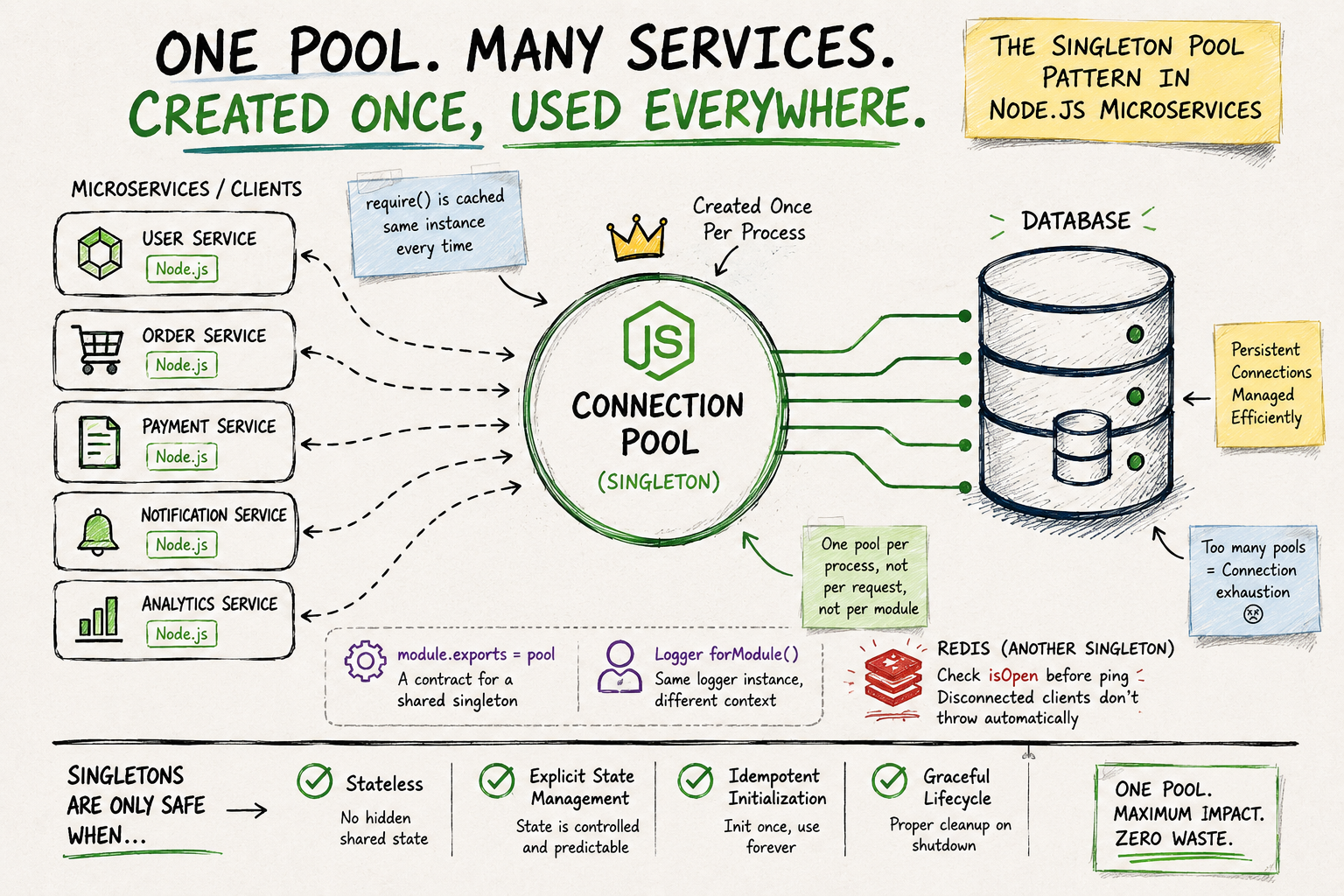
The Singleton Pool Pattern in Node.js Microservices: Why Your Database Pool Is Created Once and Never Again
Understanding the Singleton Pattern
The singleton pattern is a software design pattern that restricts the instantiation of a class to one single instance. This ensures that there is only one global point of access to that object. In Node.js, this pattern can be particularly useful for managing shared resources like database connections or Redis clients.
Singleton patterns are essential for managing shared resources efficiently in microservices architecture.
- Singleton patterns ensure a single instance of a class is created.
- They provide a global point of access to the object.
- This pattern is crucial for managing shared resources like database connections.
require() Caching in Node.js
Node.js employs module caching by default. When you use require(‘module’), it loads the module into memory and caches it. Subsequent calls to require(‘module’) will return the cached instance instead of creating a new one. This behavior is particularly beneficial for connection pools, as it ensures that only one pool instance is created per process.
const pg = require('pg');

const pool = new pg.Pool({
  user: 'myuser',
  host: 'localhost',
  database: 'mydb',
  password: 'mypassword',
  port: 5432,
});

module.exports = pool;Node.js caches modules by default, ensuring only one instance of a module is created per process.
- Node.js caches modules to improve performance.
- This behavior ensures that connection pools are reused efficiently.
- Only one pool instance is created per process.
Why Create a Pool Once?
Creating a database connection pool once and reusing it throughout your application has several advantages. First, it reduces the overhead of establishing new connections repeatedly, which can be resource-intensive. Second, it improves performance by minimizing latency associated with connection setup. Finally, it helps manage resources more efficiently, especially in microservices architectures where multiple services might need to access the same database.
Always reuse connection pools to optimize resource usage and improve application performance.
- Connection pooling reduces overhead by reusing connections.
- It improves performance by minimizing latency.
- Efficiently manages resources in microservices architectures.
Implementing Singleton Pattern for Redis
Similarly, the singleton pattern can be applied to Redis clients. By creating a single instance of the Redis client and reusing it throughout your application, you can avoid the overhead of multiple connections and improve performance.
const redis = require('redis');

const client = redis.createClient({
  host: 'localhost',
  port: 6379,
});

client.on('error', (err) => {
  console.error('Redis error:', err);
});

module.exports = client;Implementing a singleton pattern for Redis clients ensures efficient resource management and improved performance.
- Reuse Redis clients to optimize performance.
- Avoid multiple connections by using a single instance.
- Efficiently manage resources in microservices architectures.
Conclusion
The singleton pool pattern is a powerful tool for managing shared resources efficiently in Node.js microservices. By creating connection pools and Redis clients once and reusing them, you can optimize performance, reduce overhead, and manage resources more effectively. Understanding this pattern and its implementation details is essential for building scalable and high-performance applications.
Implementing the singleton pool pattern in Node.js microservices is crucial for efficient resource management and optimal performance.
- Singleton patterns optimize resource usage.
- They improve application performance by reducing overhead.
- Efficiently manage resources in complex architectures.
Subscribe to TECHScriptaid on YouTube for weekly deep-dives on enterprise architecture, AI automation, and production-grade systems.
Subscribe on YouTube →